Learning Chords on Guitar — The Visual Way to Build and Play Chords
Chord shapes stop feeling arbitrary once you can see which notes belong to them. This is what that shift looks like on a color-coded fretboard.
Read Guide →
Every note on every fret, visible in color. Most guitarists spend years with a fretboard they only half-understand. Musical Colors® changes that by making the map visible while you play.

Learning guitar is genuinely enjoyable once the fretboard stops being a mystery. The problem for most players — beginners and intermediates alike — is that the fretboard never becomes fully visible. You learn chord shapes. You learn a few scale patterns. But a complete map of where every note lives, and how those notes connect to each other, never quite comes together.
Musical Colors® fixes that by placing every note in its correct color directly on the fretboard. Not as a chart on the wall, not as a diagram you have to memorize separately — on the actual strings and frets you're playing. The color system turns the guitar from something you learn around into something you can see straight through.
A standard guitar has 144 individual note positions across six strings and 24 frets. Most of those positions share names — the note C appears in multiple places on every string. Traditional learning asks you to memorize those positions from charts and diagrams before you play them, which is slow and abstract.
Color-coded sticker guides flip this around. Every note is visible the moment the stickers are installed. You see C as the same color every time it appears, across every string, at every fret. The pattern becomes recognizable before you even consciously memorize it — because you're seeing it repeatedly while you play.
The note positions on a guitar don't change. What changes is how visible they are. Color makes every position immediately identifiable — which is why players often learn the full fretboard layout faster with stickers than they did in years of playing without them.
Notes, scales, and chords are not three separate topics in music theory — they're one system viewed from three angles. A scale is a set of notes in a pattern. A chord is three or more of those notes played together. On a color-coded guitar, you can see both at once:
Install the color-coded sticker guides and every note appears in its correct color across the entire fretboard — from the open strings to the highest fret.
A scale is a fixed set of notes in a pattern. On a color-coded neck, that pattern appears as a recognizable color sequence — visible at a glance without counting intervals.
A chord is built from the 1st, 3rd, and 5th notes of its parent scale. On a color-coded guitar, the chord notes are already visible as specific colors inside the scale pattern.
When you can see which notes belong to your key as a color pattern across the neck, you can play over those notes in real time — staying in key without calculating each move.
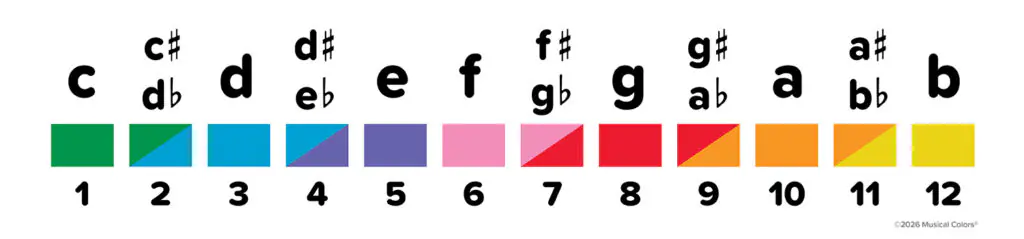
Every note on the guitar neck is one of these 12. Natural notes carry solid spectrum colors. Sharps and flats carry the two adjacent natural colors split diagonally — so you can immediately see that they sit between two natural notes.
These same colors appear at every octave, every string, every fret position on the guitar. Learn more about all 12 notes →
These guides go deeper into specific aspects of guitar learning using the Musical Colors® color system. Each is written for a real point in the learning process — not a generic overview.
Chord shapes stop feeling arbitrary once you can see which notes belong to them. This is what that shift looks like on a color-coded fretboard.
Read Guide →
Most self-taught guitarists never fully learn the fretboard. Color makes every position visible and learnable — often in far less time than expected.
Read Guide →
Once every note is visible, the ceiling on your playing rises significantly. Here's how that progression actually unfolds.
Read Guide →
The shift from reading theory to actually using it starts when you can see it on the instrument. This is what that transition looks like.
Read Guide →The fastest approach is to make every note visible before you try to memorize it. Musical Colors® guitar sticker guides place each of the 12 notes in its correct color across the entire neck — so instead of memorizing positions from diagrams, you learn by seeing and playing simultaneously. Most players can identify all 12 notes by color within a few days.
Every chord is built from a scale. A major chord uses the 1st, 3rd, and 5th notes of a major scale. On a color-coded fretboard, those note colors appear inside the scale pattern — so the chord-to-scale connection becomes something you can see rather than something you have to calculate separately. The Chords page covers this visually.
Yes — as long as you can see which notes belong to your key. Color-coded fretboard guides show the scale as a visible pattern across the neck. You can stay in key while improvising without needing to calculate each note in real time. This is actually how Musical Colors® was originally created — Michael Wiley needed a way to improvise on guitar and stay in key while playing, not a way to study theory on paper.
The color-coded sticker guides are designed for standard tuning and the most common alternate tunings. Because the same note always carries the same color regardless of fret position or string, the visual logic still holds across different tunings — the note layout shifts, but the color identification stays consistent. Contact Musical Colors® directly for custom tuning requests.
The same visual color system that works on guitar applies across every instrument Musical Colors® supports — so knowledge transfers between instruments naturally.